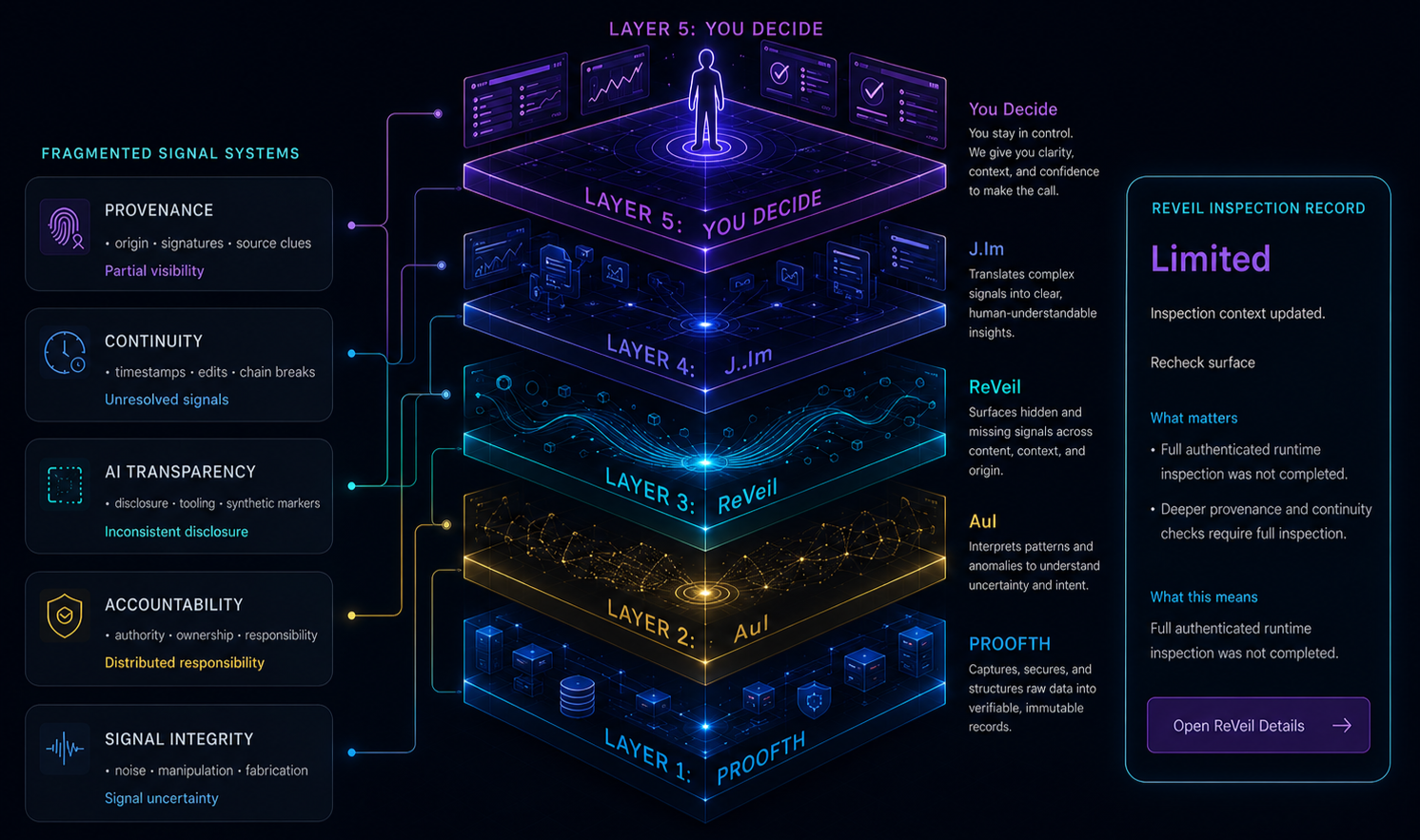
The problem is not just AI content. It’s not knowing what’s missing behind the information people and AI systems are being asked to trust.
ReVeil helps surface signals, gaps, and uncertainty before people trust, share, sign, approve, route, execute, or act.
Start with one inspection
What ReVeil may surface:
Authorship is unclear. Origin signals are weak.
Terms may change without clear notice.
Disclosure exists, but accountability is fragmented.
No judgments.
No recommendations.
No predictions.
Powered by Proofth
A calm understanding layer for AI-mediated decisions.
ReVeil is the inspection experience people interact with. Proofth is the infrastructure underneath — structuring visibility, accountability, continuity, and machine-readable inspection records.
⊕Paste anything
→
≡Signals surfaced
→
△Gaps revealed
→
▣Inspection record created
What ReVeil surfaces
Not more noise. Clearer inspection conditions.
Missing origin
Who made this may not be visible.
ReVeil surfaces when authorship, source, or origin signals are not clearly present.
Broken continuity
The chain may not fully connect.
Spot gaps across timestamps, edits, references, and visible source continuity.
Conflicting disclosure
The story and signals may not align.
Surface mismatches between disclosure, claims, context, and visible evidence.
Weak accountability
Responsibility may be unclear.
See where ownership, authority, or review responsibility is fragmented.
Recheck needed
Some signals require deeper inspection.
ReVeil shows when the surface view is not enough to support confidence.
For people and teams who cannot afford to act on invisible assumptions.
Journalists
Legal teams
Enterprise review
Creators
Researchers
Why ReVeil matters
The future is not just AI-generated. More decisions are now shaped by AI systems people cannot fully see.
People are not only reading information anymore. They are reading summaries, feeds, recommendations, rankings, edits, outputs, and machine-shaped interpretations.
▦
Media & Journalism
Surface origin, disclosure, and accountability signals at the moment of review without declaring content true or false.
⟲
Investigations
Generate inspection records that show what was visible, what was missing, and where uncertainty remained.
Ⅱ
Enterprise & Internal
Support review, escalation, and documentation workflows before decisions move forward.
◉
Creators & Individuals
Inspect links, policies, posts, and media before trusting, sharing, signing, or acting.
Why ReVeil
The next challenge is not more AI. It is understanding what AI can see.
For years, technology helped organizations answer operational questions: Is the system running? Did the workflow complete? Where did the failure happen?
Those questions still matter. But in an AI-mediated world, another question becomes unavoidable:
What was visible before the decision was made?
Observability explains what happened.
Modern monitoring helps teams understand what occurred after a system, workflow, or action has already taken place.
Decision visibility explains what was visible.
ReVeil focuses on the conditions present before a decision, including missing, broken, conflicting, unclear, and unresolved signals.
AI can execute correctly and still be wrong.
An AI system may follow instructions perfectly while acting on incomplete, hidden, manipulated, or low-visibility information.
Visibility comes before accountability.
If people cannot inspect what was visible at the moment of a decision, accountability becomes harder to establish afterward.
Traditional Question
What happened?
ReVeil Question
What was visible before it happened?
Before a person trusts
Before an AI agent acts
Before a recommendation is accepted
Before a policy is signed
Before a link is shared
Before a workflow moves forward
ReVeil does not judge information. ReVeil does not recommend actions. ReVeil does not predict outcomes.
ReVeil helps expose visibility conditions before people and AI systems trust, share, sign, approve, route, execute, or act.
Decision visibility signals
Accountability begins with what can be inspected.
ReVeil organizes visible signals into inspection conditions so uncertainty can be surfaced before a decision moves forward.
Provenance
origin · signatures · source clues
Partial Visibility
Continuity
timestamps · edits · chain breaks
Unresolved signals
AI Transparency
disclosure · tooling · synthetic markers
Inconsistent disclosure
Accountability
authority · ownership · responsibility
Distributed responsibility
ReVeil
Start with one inspection
Before you trust the outcome, understand the conditions.
ReVeil surfaces what remains unresolved before decisions move forward.